Laying the foundation for care pathways in mental health
How the ACT Center is bridging research and real-world care to help Kaiser Permanente Washington improve access to mental health care
October 8, 2026
Laying the foundation for care pathways in mental health
How the ACT Center is bridging research and real-world care to help Kaiser Permanente Washington improve access to mental health care
In this blog, ACT Center team members Brandi Crawford-Gallagher, LICSW, and Sunday Brush, MSW, share their perspectives on a Learning Health System (LHS) Program partnership at Kaiser Permanente Washington. Brandi is a research interventionist and licensed clinical social worker. Sunday is a project manager and the ACT Center’s patient engagement lead.
One key benefit of learning health systems is that they provide a bridge that directly connects research capabilities to everyday clinical care. This encourages a culture of continuous learning — and gives health care organizations the ability to continually design, evaluate, and implement evidence-based improvements. Through Kaiser Permanente Washington’s Learning Health System (LHS) Program, our ACT Center team partnered with the Mental Health and Wellness (MHW) department to support the department’s goal of improving timely access to care for members seeking mental health treatment.
The MHW department’s goal is to implement evidence-based care pathways across common mental health conditions like depression and anxiety disorders. Care pathways are structured treatment plans that support collaborative, goal-oriented episodes of mental health care.
Our ACT Center work began with a series of evidence scans examining the research base for various mental health treatments and their duration. We started by summarizing the results of high-quality studies on treatment for anxiety and depression and ultimately completed evidence summaries across 13 categories of mental health conditions. Our results highlighted the strengths and limitations of the evidence-based treatments currently available and the need to balance research findings with real-world clinical practice.
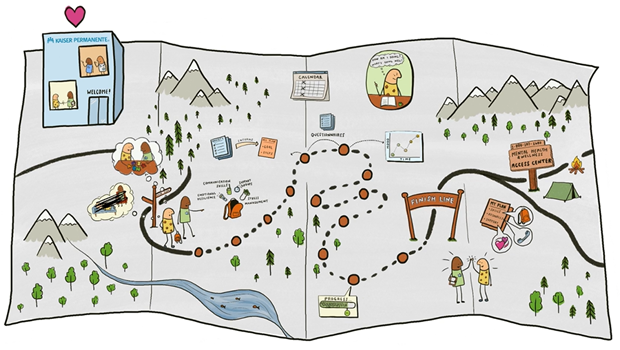
The important work of real-world implementation is another key area where our LHS Program acts as a vital bridge to help accelerate care improvement. To support MHW’s ultimate objective of implementing care pathways for mental health conditions, our team created new reporting tools in Kaiser Permanente Washington’s electronic health record to help track patients’ progress toward therapeutic goals. We also developed resources to help therapists and patients work together to successfully navigate individual, goal-oriented treatment paths.
For both of us, the project provided a valuable opportunity to connect our scientific expertise with our unique experiences in clinical care and patient engagement. Below, we share how this helped us orient our recommendations for MHW’s future work through a pragmatic, patient-centered lens.
Brandi: Grounding research results in everyday clinical practice
My role on this project allowed me to leverage my experience as both a clinical social worker in mental health practice and a research interventionist working on a variety of mental health-related research trials. Working in clinical practice gave me insight into the realities of delivering person-centered care in dynamic clinical environments — where individualized care for complex patients, the art of therapy, and clinical judgment are essential. At the same time, my experience implementing rigorous, protocol-driven research interventions has shown me how faithfully applied, evidence-based treatments can lead to meaningful and measurable improvements in patients' quality of life and increase my confidence and satisfaction as a therapist.
As the lead for the rapid evidence scans, my goal was to provide our MHW partners with balanced, actionable information that could bridge research and practice in our particular setting. The work involved synthesizing the available evidence, assessing its applicability and limitations for Kaiser Permanente Washington, and providing recommendations for each condition and across conditions. I answered the central question in the scans around typical duration for evidence-based treatments — but also sought to answer practical questions about other ways to support patients. For example: When is a combination of pharmacotherapy and psychotherapy the best evidence-based treatment? When can patients move to a lower level of care while still meeting their treatment goals? And what additional trainings would be most beneficial to offer to Kaiser Permanente mental health therapists?
Our recommendations for MHW’s future work were based on a both/and approach: Use evidence-based treatments and a framework for duration to guide patient care, and individualize it for each patient according to their needs, preferences, and response to treatment.
Sunday: Ensuring a patient-centered approach to communication
One key capability I brought to our collaboration with MHW was to help keep our work grounded in patient-centeredness. Over the past several years, I’ve been fortunate to partner with patients on a variety of research projects. Patients are lived-experience experts, and there are so many reasons to meaningfully engage them in research. Listening to and incorporating patient perspectives makes study design and outcomes more relevant, improves the quality of interventions, and builds trust with community.
My experiences in research honed my patient-centered communication skills and steered me toward a Master of Social Work, which I was finishing while working on this project. The insights I brought — both from learning about evidence-based mental health practice in school and from partnering with patients to design human-centered interventions and tools — were important to the success of this project.
A primary example is a video I developed for members starting their mental health journey with Kaiser Permanente Washington. Our team is currently exploring ways to translate the video into languages other than English, so that more members can benefit from it. The video emphasizes the importance of patients as collaborators in their care — working with providers to set goals and make measurable progress toward them. Evidence suggests that people who set goals have improved outcomes in mental health care. But saying, “Research suggests that it’s helpful to set goals …” is not enough to bring most people on board.
Finding practical, sustainable ways to move research into practice is the foundation of the ACT Center’s work. An essential part of that foundation is considering the experience of patients and how we bring respect, dignity, and understanding to the fore in our communications.