Closing the gap in recognizing cognitive impairment
How Kaiser Permanente Washington is leveraging research to improve dementia screening, diagnosis, and care
March 19, 2026
Closing the gap in recognizing cognitive impairment
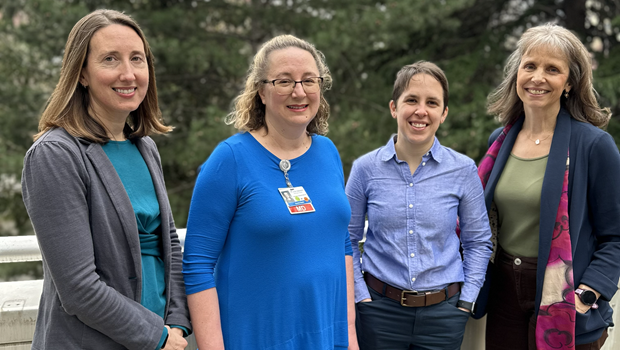
ACT Center team members who are collaborating on Kaiser Permanente Washington’s Dementia Program (L to R): Brandi Crawford-Gallagher, Sascha Dublin, Yates Coley, and Paula Lozano
How Kaiser Permanente Washington is leveraging research to improve dementia screening, diagnosis, and care
By Paula Lozano, MD, MPH, associate medical director for research and translation at Kaiser Permanente Washington and co-director of the Center for Accelerating Care Transformation (ACT Center) at Kaiser Permanente Washington Health Research Institute
One of the best things about being part of a learning health system like Kaiser Permanente Washington is the opportunity to bring expertise and findings from our own research institute directly to our health plan leaders and care teams so we can provide better care to our members. The ACT Center is excited to be launching a new Learning Health System (LHS) Program partnership that illustrates this opportunity perfectly.
The new Memory and Cognitive Health Program brings together researchers from Kaiser Permanente Washington Health Research Institute (KPWHRI) and care delivery leaders in Quality and Primary Care at Kaiser Permanente Washington. Our goal is to improve cognitive care at Kaiser Permanente Washington by ensuring that all members who might have undiagnosed dementia or mild cognitive impairment are offered screening and, if appropriate, in-depth assessment and follow-up.
Creating a tailored solution for a widespread problem
Underdiagnosis of dementia is a common problem nationwide: About half of people living with dementia don’t know they have it because they haven’t been diagnosed. This can affect all aspects of their lives, making them vulnerable to financial scams, accidents, and worsening of chronic medical conditions due to difficulty managing medications and self-care. Kim Painter, MD, MPH, special populations medical director at Kaiser Permanente Washington, recognized this problem and asked the ACT Center if we could help find a solution. We were thrilled to say yes and to join forces with our KPWHRI colleague Sascha Dublin MD, PhD, a senior researcher and Kaiser Permanente Washington physician whose clinical work often includes evaluating and following up with older patients experiencing cognitive impairment.
Kim’s vision was to have a practical, sustainable way to help ensure primary care teams are identifying all older members who might benefit from dementia screening and offering them screening and follow-up support. Sascha and colleagues from KPWHRI and the University of California (UC) San Francisco had recently developed eRADAR — an electronic health record (EHR) tool designed to help identify people at high risk of having undiagnosed dementia. This potential solution from research aligned with care delivery’s need, so the ACT Center set about facilitating a partnership, helping define project scope and goals, building a team to support tailored design and implementation, and preparing for an evaluation to guide program improvements and sustainment.
At our project team’s kickoff meeting in early February, it was exciting to hear the perspectives that Sascha and Kim brought to the table as we looked ahead to what we hope to accomplish together.
Sascha: How eRADAR provides an evidence-based solution and insights into patient and provider preferences for dementia screening
From my work as both a researcher and a primary care physician, I know that getting a diagnosis of dementia or mild cognitive impairment sooner provides patients with opportunities to get better care and plan for their future — and for their families to get involved in supporting them. The eRADAR study came about because my fellow researchers and I started wondering if there might be a sort of fingerprint in the EHR that would let us know which patients are likely to have dementia that hasn’t been recognized yet because they are not aware of their impairment or haven't come to their care team to ask for help.
We were fortunate to be able to use data from the Adult Changes in Thought (ACT) Study, a collaboration between KPWHRI and the University of Washington that is the longest-running study of cognitive health in the country. This study provides decades worth of incredibly high-quality research data from Kaiser Permanente members as they age — which gave us a rigorous way to compare Adult Changes in Thought Study data (which uses “gold standard” measures of dementia) to EHR data to see whether patients whom the study identified as having new dementia had already been given a dementia diagnosis.
Then we used predictive modeling to learn how to use EHR data to predict who might have undiagnosed dementia based on known risk factors for dementia risk — like age and history of stroke or diabetes — and other factors that may be early signs of dementia, such as sleep problems or problems with balance when walking. We then did an embedded, pragmatic trial implementing the eRADAR model in 11 primary care clinics at Kaiser Permanente Washington and UC San Francisco. We found that among people with a risk score in the top 15%, half had either dementia or mild cognitive impairment, showing that our model does a good job of finding people who have cognitive impairment and probably would benefit from a diagnosis.
I’m thrilled to work with Kim to leverage what we learned to integrate the eRADAR tool into Kaiser Permanente Washington’s EHR and improve care for our members with cognitive impairment. Importantly, the eRADAR study also included interviews with patients and primary care providers about what the experience was like for them. In our outreach to patients, we learned that some people didn’t want to come in for cognitive screening, which signals that we need to respect people's autonomy and their right to opt out. As this project moves forward, whenever our care delivery partners have questions about patient and provider preferences for dementia screening, we can draw on our research findings for useful insights.
Kim: How the program creates a patient-centered, primary care-based approach to closing the gap in dementia diagnosis
I've been eager to work with the ACT Center to help us improve diagnosis of dementia because I’ve seen data that clearly shows we have members who are undiagnosed, which is a problem for those patients and their families because they’re missing the opportunity to make plans together while they still can. It also impacts Kaiser Permanente Washington’s quality metrics — because if we’re not finding all the patients who might not be able to remember to take their medications because of dementia, then control of chronic illnesses like diabetes and hypertension will suffer.
Knowing that Sascha and the eRADAR team had an evidence-based EHR tool to reliably predict dementia risk seemed like the answer to helping us identify which patients would benefit most from cognitive screening. Plus, I know from being part of other ACT Center partnerships that we will benefit from their team’s unique expertise in implementation. The ACT Center brings sophisticated analytic tools and proven protocols to the often-challenging work of building, spreading, and sustaining a new program like this.
I’m excited that this project will provide a check and balance for the patients who are at high risk for having dementia, but who don’t yet have a diagnosis. Having new EHR-based resources and workflows will help us improve dementia diagnosis as part of standard work in primary care, with support from geriatrics providers for any members whose needs might be more complex. If we're successful, it will strengthen the foundation for geriatrics as an integral part of Kaiser Permanente Washington’s approach to patient-centered care.
The Memory and Cognitive Health Program team includes: