How the ACT Center helped Kaiser Permanente Washington implement a practical new approach to cervical cancer screening
June 29, 2026
From research evidence to real-world innovation
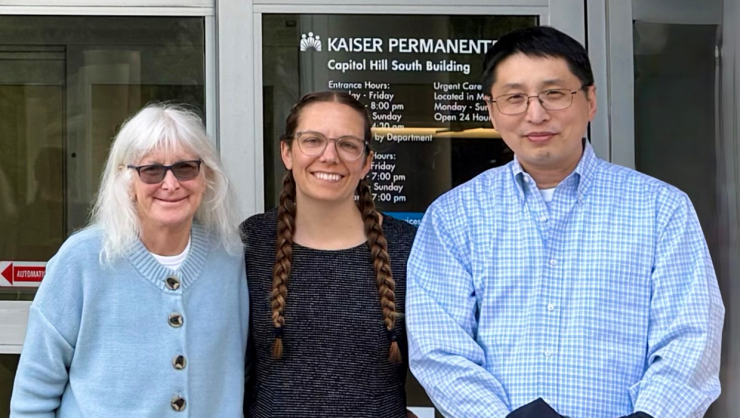
L to R: Bev Green, Jess Mogk, and Stanley Shyn at Kaiser Permanente Washington’s Capitol Hill Medical Center
How the ACT Center helped Kaiser Permanente Washington implement a practical new approach to cervical cancer screening
More than half of cervical cancers in the U.S. are diagnosed in people who are overdue for screening — which typically involves a test for human papillomavirus (HPV) collected during a pelvic exam. In 2023, Kaiser Permanente Washington became the first health care organization in the country to offer HPV self-collect as a way to help more people get timely screening.
This innovation gives people the option to skip the pelvic exam and collect their own vaginal samples to test for HPV. It grew directly from research co-led by Kaiser Permanente Washington physician scientist and ACT Center partner Bev Green, MD, MPH, that showed mailing HPV self-collect kits significantly increased cervical cancer screening rates among members due or overdue for screening. By the time the results were published in JAMA, Kaiser Permanente Washington had already started offering HPV self-collect to members — creating a patient-centered alternative to the usual in-person exam that removes barriers like lack of time or transportation, which can keep people from getting screened.
Real-world implementation, however, brings challenges not faced in grant-funded research. So, Stanley Shyn, MD, PhD, Kaiser Permanente Washington’s medical director of population health at the time, partnered with Dr. Green and a team from the ACT Center to conduct a formative evaluation to help improve and sustain implementation and to inform spread to other Kaiser Permanente regions. The evaluation showed that the self-collect program boosted cervical cancer screening rates and is benefiting both patients and care teams — results that were recently published in NEJM Catalyst and shared nationally by Kaiser Permanente. In this Q&A, Dr. Green and ACT Center Collaborative Scientist Jess Mogk, MPH, talk about what makes this project unique, what they learned along the way, and how they hope to carry the work forward to continue making cervical cancer screening easier for people everywhere.
What was the recipe for success in this project?
Bev Green (BG): The ACT Center’s evaluation had strong sponsorship from Kaiser Permanente Washington leaders and a groundswell of excitement from care teams. Based on the results of our 2023 study, leaders were eager to roll out the self-collect program right away. That rarely happens after a grant-funded research study. They also did something innovative that wasn’t part of the study: in-clinic kit distribution. Care teams can offer HPV self-collect kits during any type of primary care visit, which is important for patients who are overdue for screening and for people avoiding screening for cultural, identity, or trauma reasons.
Jess Mogk (JM): From a practical standpoint, it was really helpful that the research occurred here at Kaiser Permanente Washington. Because of that, the research team had already worked out a lot of implementation hiccups before the program launched. I also think this specific intervention is unique because it meets a need to increase screening without requiring an in-person visit. It makes cervical cancer screening easier for both patients and care teams while also helping improve access by freeing up appointment times. Before the self-collect program, all cervical cancer screenings at Kaiser Permanente Washington were completed in person. By the end of our 6-month evaluation, more than a quarter of screenings were done by self-collect.
BG: And in qualitative interviews, we found that both patients and care teams were enthusiastic about the self-collect option. Importantly, self-collect can help boost health equity: Kaiser Permanente Washington provides the kit instructions in 15 languages — including Spanish, Chinese, and Somali — and our research has shown similar increases in screening rates across races and ethnicities. The test is also incredibly accurate. With self-collect kits for colon cancer screening, the test detects 70% to 75% of people who have cancer and 30% to 35% that have pre-cancers. The HPV self-collect test picks up 90% to 95% of pre-cancers, which is phenomenal. And for each additional completed screening, self-collect actually saves money, which is rare in a quality improvement intervention.
What were your ah-ha moments during the evaluation?
JM: We got to tour the Kaiser Permanente Washington Central Lab, which was really illuminating. With a full rollout of the program, the lab had to ramp up to analyze a much larger volume of self-collect kits than during the research study. Seeing the day-to-day workflow helped us work with the lab team to pinpoint changes to kit packaging and processing that boosted efficiency.
BG: Because the evaluation gave us the opportunity to hear directly from care teams during site visits and interviews, we picked up on a knowledge gap about the accuracy of the self-collect test. Clinicians got really excited when we told them that the test is just as good as conducting a pelvic exam. Another thing that surprised us is that screening rates didn’t increase as much as they did in our earlier study. Jess was essential in helping us dive into the data to figure out why the results were different. And it turns out that, in the initial rollout of the program, self-collect kits were mailed to people who were coming due for screening, while people who were overdue were put on temporary hold to allow the lab to process the first wave of kits. After a leadership transition in the department, lifting that hold fell through the cracks. But Jess spotted it in the data during our evaluation, and we alerted the lab so those kits could be sent out right away.
JM: Without the ACT Center evaluation and our partnership with Kaiser Permanente Washington, this gap in implementation might not have been discovered so quickly. Our care delivery partners are experts in the challenging day-to-day reality of health care — juggling competing priorities and working hard to make new processes fit in a practical way that doesn’t overwhelm the lab or any other department. It was a good decision to phase the rollout like they did, and it’s understandable that something fell through the cracks. But without looking at the data, the gap wouldn’t have surfaced. This emphasizes how important it is to have metrics for tracking implementation so programs like this can adjust quickly to be most effective.
This work is changing the landscape of cervical cancer screening — what’s coming next?
BG: Because HPV self-collect is a new test, there’s obviously a knowledge gap. Closing that gap for both clinicians and patients will help streamline implementation. I think future research should explore ways to do that by educating clinicians and standardizing workflows to normalize self-collect as a trusted option for cervical cancer screening. We also need simple but effective resources for communicating with patients about self-collect, and I’m currently evaluating a video for that purpose in a federally funded research study involving 42 Federally Qualified Health Centers nationwide. Studying implementation in community clinics is essential because they face different challenges than we do in an integrated system like Kaiser Permanente — especially with things like producing mass mailings and tracking important outcomes.
JM: Within Kaiser Permanente, we've heard a lot of excitement from other regions that want to implement a self-collect program for cervical cancer screening. Kaiser Permanente Washington is on the cutting edge in this space, and I’m thrilled that we have relationships through the ACT Center that connect us to Kaiser Permanente colleagues from across the country. It gives us the chance to share what we learned and help other regions leverage our program’s success and avoid the implementation challenges that surfaced during our evaluation. That’s the benefit of being a learning health system: We can take our experience here in Washington and use it to spread what we know went right and help implementation go even smoother next time.
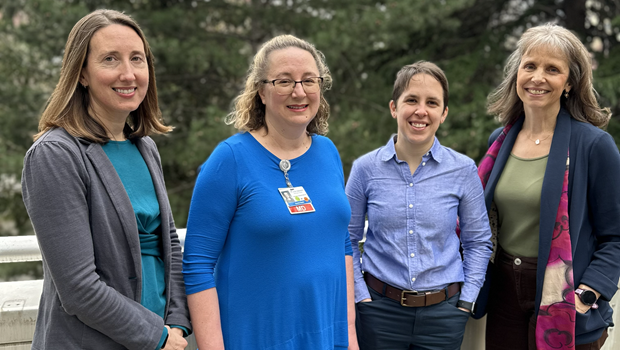
Bev and Jess would like to thank all the members of the evaluation team for contributing to the project’s success: