ACT Center study finds that patient-centered opioid safety committees can help lower high-dose opioid prescription in primary care
October 6, 2026
What works to reduce high-dose opioid prescribing?
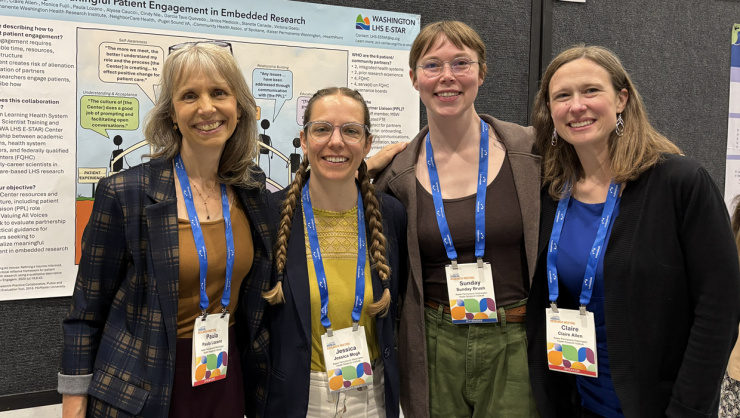
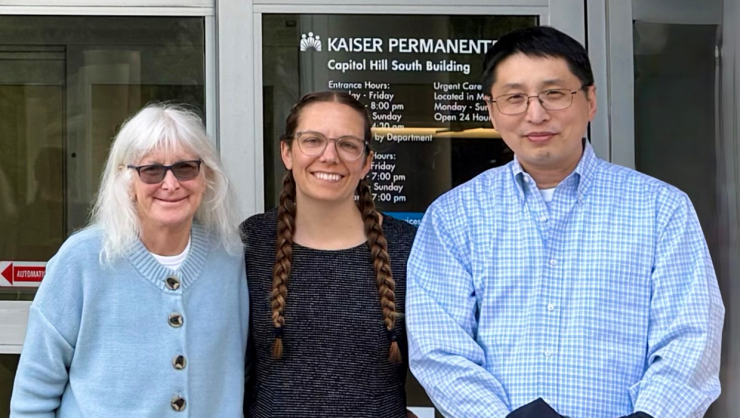
Study coauthors L to R: Paula Lozano, Jess Mogk, Sunday Brush, and Claire Allen.
ACT Center study finds that patient-centered opioid safety committees can help lower high-dose opioid prescriptions
In the decades since prescription opioids emerged as a widely used treatment for persistent pain (also called chronic pain), health care organizations have been looking for effective ways to balance the benefits of opioids with their proven harms — such as increased risk of opioid use disorder and accidental overdose.
In response to this need, the ACT Center partnered with care teams and patients at Kaiser Permanente Washington on a Learning Health System (LHS) Program project to design and test a new, primary care-based approach to providing safer treatment for persistent pain. The result was the Integrated Pain Management (IPM) Program, which established Opioid Safety Committees (OSCs) in 9 primary care clinics to identify and implement best practices for opioid prescribing. A key OSC objective was to reduce long-term, high-dose opioid prescriptions (defined 90 or more morphine milligram equivalents per day) — while still providing compassionate, whole-person care for people living with ongoing pain.
A new paper from the ACT Center shares results from the program evaluation, which found that high-dose opioid prescribing declined by 19% in Kaiser Permanente Washington primary care clinics with OSCs. Published in BMC Primary Care, the paper also explores key factors that supported the OSCs’ efforts to improve opioid prescribing safety in a practical, sustainable, and patient-centered way.
What are opioid safety committees? And how can they help improve opioid safety?
As clinical guidelines around opioid prescribing have become more stringent, health care organizations nationwide have established various “opioid stewardship” programs to try to reduce high-dose prescribing. But no clear blueprint exists for what contributes to overall program effectiveness or how to ensure programs are designed to be patient centered.
“The idea to form opioid safety committees (OSCs) at Kaiser Permanente Washington stemmed from early evidence that suggested establishing interdisciplinary clinical teams could be an effective way to reduce high-dose opioids,” explained Claire Allen, MPH, codirector of the ACT Center and the paper’s lead author. “Through our LHS Program, we were able to connect with key clinical partners in pharmacy and primary care and to provide practice facilitation to help launch and sustain OSCs in 9 primary care clinics.”
The OSCs, all of which are still operating today, consist of primary care providers, social workers, pharmacists, clinic operations leaders, and other care team members who meet regularly to review the cases of patients with high-dose opioid prescriptions. Committee members work together to find opportunities to help patients taper to a lower opioid dose and to explore other evidence-based ways to manage ongoing pain.
The program evaluation, which was led in collaboration with Kaiser Permanente Washington Health Research Institute’s Center for Community Health and Evaluation, compared opioid prescribing rates in primary care clinics with and without OSCs — specifically looking at high-dose opioid prescribing and concurrent prescribing of opioids and benzodiazepines. Both rates dropped significantly in the 9 clinics with OSCs after the committees had been operating for one year.
OSCs were able to reduce high-dose opioid prescribing by identifying patients who would benefit from conversations on opioid risks and developing scripting to help care teams have those discussions. The OSCs also developed a chart audit tool to assess patients for opioid use disorder and mental health conditions — so that care teams could connect patients to additional services when needed.
“One of the most important things we learned is that it takes time — in this case about a year — for changes like these to make a meaningful difference in high-dose opioid prescribing,” said Paula Lozano, MD, MPH, ACT Center codirector and the paper’s senior author. “Supporting OSC implementation with ongoing practice facilitation was a key component of the program’s long-term success. ACT Center practice facilitators guided the committees at every step — from starting with an assessment of current opioid prescribing practices to defining key priorities for improvement to implementing new processes to support those priorities.”
Another key to the program’s success: Keeping patients at the center
As part of the evaluation, the team conducted interviews with 55 OSC members to shed light on what contributed to the program’s positive outcomes. In addition to practice facilitation and the interdisciplinary approach to patient review, the program’s uniquely patient-centered approach emerged as a key positive.
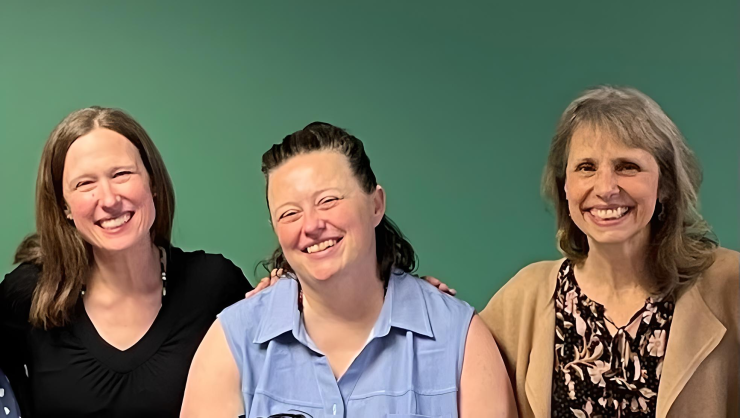
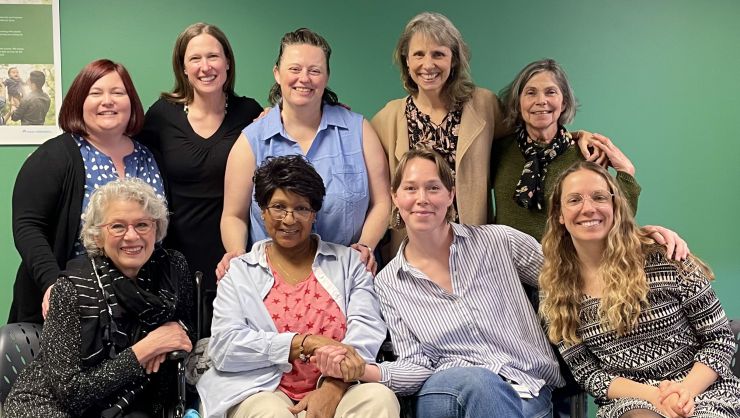
Before setting out to design the IPM program, the ACT Center recruited 4 Kaiser Permanente Washington members who have lived experience with persistent pain to serve as patient partners across the life of the project. The patient partners provided input into OSC design and implementation decisions — helping ensure that provider scripting, educational materials, and care plans were respectful, relevant, and meaningful to real people living with ongoing pain. A key example: Based on patient partner preferences, the IPM Program uses the terms “persistent pain” or “ongoing pain” instead of “chronic pain,” which patients felt was overly negative and stigmatizing.
“Our patient partners were the heart and soul of this project,” said Sunday Brush, MSW, the ACT Center’s lead for patient engagement. “They worked alongside our team and the OSCs for more than 3 years, and we’re so grateful for their invaluable contributions and how they helped make the IPM program more accessible and more aligned with patient needs and values.”
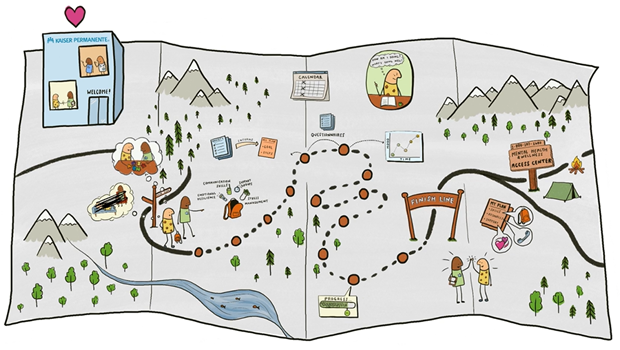
In addition to providing valuable insights to guide the OSCs, the IPM patient partner group coauthored the Toolkit for Managing Persistent Pain, a publicly available resource to help people work with their health care teams to manage opioid treatment and explore other evidence-based treatments for persistent pain. (Download the toolkit in English or in Spanish.)
“The toolkit was designed by patients for patients, and we hope it will be a useful resource for anyone experiencing ongoing pain,” said IPM patient partner Starette Canada. “My advice to them is to never allow anyone to label your pain and to adapt this toolkit to your level or cause of pain, no matter what treatment methods you are using.”
Read more about the patient toolkit and the contributions of our patient partners: